
Hypernetworks That Generate LoRA Adapters Personalize On-Device LLMs Without Gradient Descent
On September 21, 2026, Sean Augenstein and colleagues at Google published a paper describing a method for personalizing on-device LLMs that avoids both main drawbacks of existing personalization approaches. The technique trains a hypernetwork to take examples of a user’s writing behavior and produce a personalized LoRA adapter using only neural-network forward passes. No gradient descent runs on the phone. The resulting LoRA attaches to the base model, adding no prompt length and no inference latency overhead.
Why On-Device Personalization Is Hard
Mobile devices now ship with on-device LLMs through APIs like Android AICore, Apple’s on-device models, and Microsoft’s NPU stack. These models are necessarily smaller than cloud counterparts because they must fit within a phone’s RAM budget. Smaller models have less capacity, which makes any quality improvement more impactful — and personalization is one of the few quality levers that doesn’t require a larger model.
The two standard approaches to LLM customization each break in the mobile context in a specific way. Parameter-efficient fine-tuning (PEFT), including LoRA, requires running gradient descent through the base model. The authors note that “memory requirements for fine-tuning … models are drastically higher than for standard inference,” which makes PEFT computationally infeasible on a mobile device for current on-device LLMs sized to just fit inference within a phone’s RAM. In-context learning (ICL) avoids gradient descent but adds user examples directly to the prompt, increasing input sequence length, raising inference latency, and degrading quality as context grows. Research by Liu et al. (2023) and Li et al. (2024) shows ICL quality drops as context length grows, and ICL is also biased toward examples at the start and end of input sequences.
There is also a subtler problem. A phone’s input sequence serves multiple uses simultaneously: conversation history, task context, retrieval-augmented content. An on-device personalization method that consumes sequence capacity for user examples competes with all of those uses. The paper targets longer-term persona personalization precisely to preserve input sequence capacity for immediate query-related personalization. The two are treated as complementary: hypernetworks handle stable traits, context handles the moment.
The Hypernetwork Architecture
The hypernetwork takes user context tokens as input — a set of (query, desired response) example pairs from the user’s history, concatenated into a single sequence — and produces as output a complete set of LoRA matrices for the target LLM. Those A and B matrices attach to the target model, converting it into a personalized version. After the LoRA is generated, the hypernetwork parameters can be deleted from the device; only the LoRA remains.
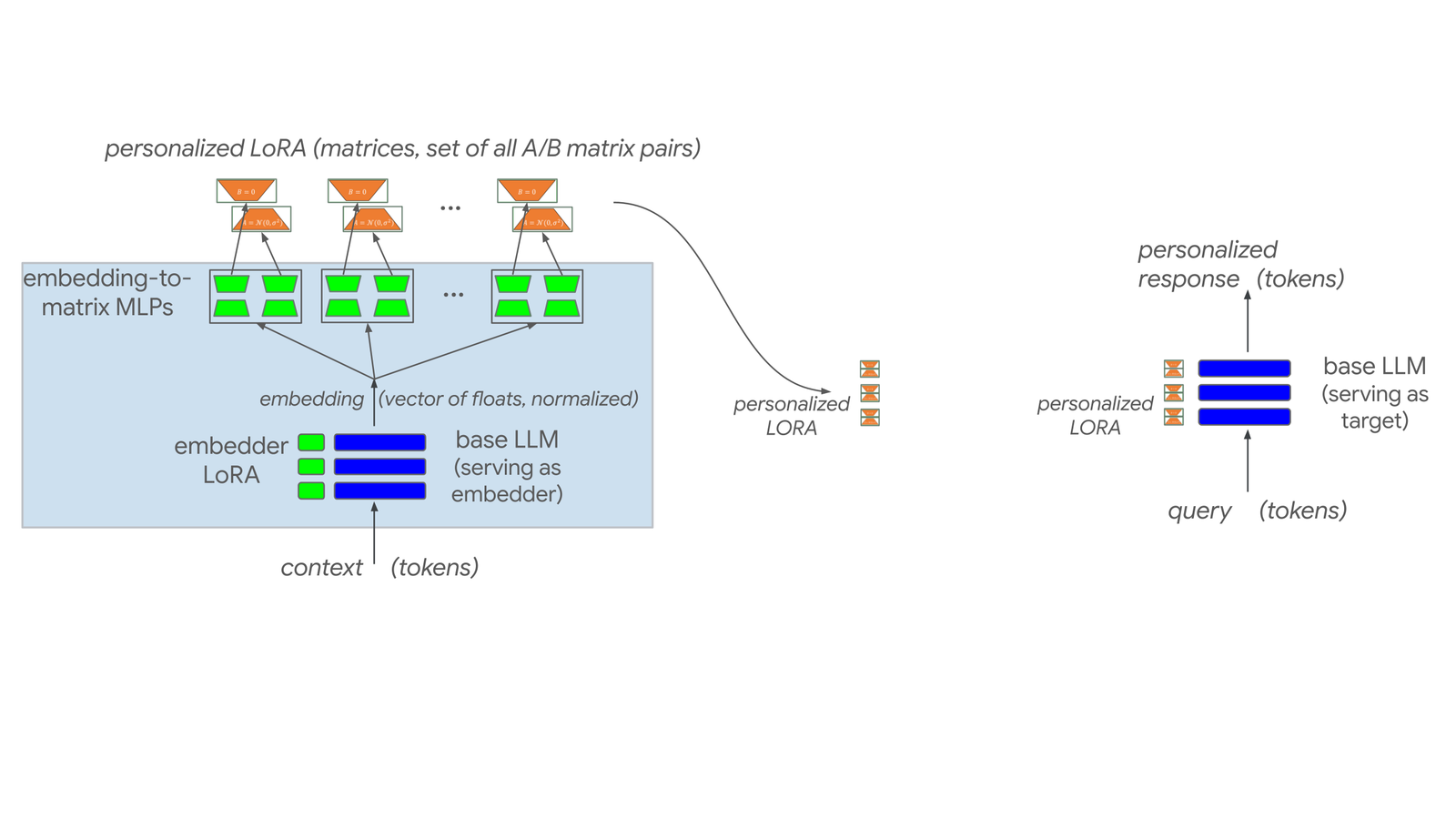
The architecture reuses the on-device LLM itself rather than introducing entirely new parameters. The frozen base model acts as the foundation of a text encoder. A small learnable “embedder LoRA” attaches to it, converting the base LLM into a bespoke text encoder tuned to the personalization task. This embedder LoRA maps the user’s context examples to an embedding vector — a point in a latent user space representing that user’s traits and writing style.
From that embedding vector, a bank of parallel two-layer feed-forward MLPs generates the actual LoRA matrices. Each MLP takes the embedding and produces one A or B matrix for a particular weight matrix in the target LLM. The MLPs use a bottleneck intermediate layer: a vector much smaller than the embedding feeds into a second layer whose weights function as a set of learned “principal” LoRA matrices. The first layer maps the user embedding to coefficients for those principal matrices. This is analogous to the EigenLoRAx approach of decomposing LoRA into a shared basis plus per-user coefficients, but here the entire mapping is learned end-to-end. The width of the bottleneck is a hyperparameter (k); selecting its value is roughly analogous to selecting how many singular values to retain in a low-rank decomposition.
Three Phases, One Separation of Concerns
The paper separates personalization into three phases. Phase 1 — training the hypernetwork — happens once, off-device, for the entire user population. It is computationally expensive: backpropagation through two LLMs simultaneously (the target LLM and the hypernetwork). Phase 2 — generating a user’s personalized LoRA — happens once per user, on-device, requiring only forward passes. Phase 3 — inference with the personalized LoRA attached — happens per query, at standard latency with no additional sequence length. Table 1 in the paper compares these phases across methods: ICL has the highest per-query latency; per-user PEFT via gradient descent has the highest per-user compute; the hypernetwork approach moves expensive computation into Phase 1, which is the least constrained phase, and minimizes compute in Phases 2 and 3, which must run on a phone.
Training: Contrastive Pretraining and ICL Distillation
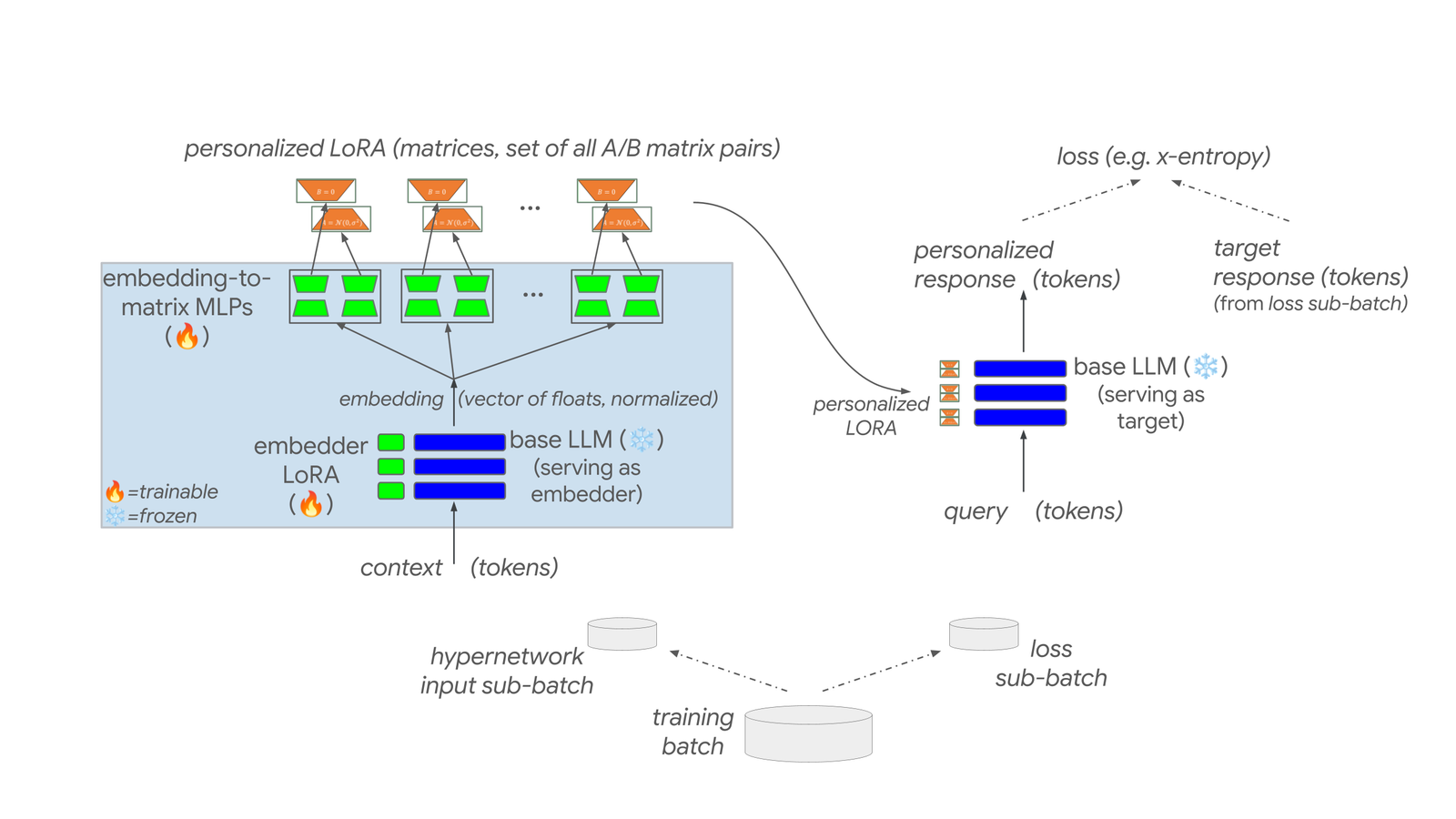
Training the hypernetwork has two stages. The first is LLM2Vec-style contrastive pretraining of the embedder LoRA only. This teaches the encoder to place different users far apart in the latent user space based on their writing characteristics — a straightforward application of the SimCSE algorithm, using positive pairs of the same user’s examples and negative pairs from different users.
The second stage trains all hypernetwork parameters end-to-end. At each step, a cohort of users is sampled. For each user, two disjoint batches are formed: one provides the hypernetwork’s input context, the other provides the token cross-entropy loss targets. A LoRA is generated from the context batch, attached to the target LLM, and the model’s predictions on the second batch are scored. Gradients propagate back through both LLMs. A notable addition is context distillation: ICL serves as a teacher model, and the hypernetwork learns to match its soft output labels across many different users’ contexts. The paper reports this distillation step to be “highly beneficial.”
Results on Personalization Datasets
Experiments used three user-partitioned personalization datasets — including LaMP and LongLaMP — across representative on-device LLMs. The paper focuses specifically on long-form text generation tasks, which it identifies as “more challenging and less studied” for personalization and as “understudied via hypernetwork-based approaches.” In all tested configurations, hypernetwork-generated LoRAs deliver quality “equal or better” than ICL and per-user PEFT via gradient descent, while requiring only on-device forward passes during deployment.
Crucially, experiments use disjoint training and test users: the hypernetwork is evaluated on users it has never seen, testing whether it generalizes to novel user profiles rather than simply memorizing training-time users. This is the harder and more practically relevant evaluation — in a real deployment, the hypernetwork must synthesize LoRAs for users whose examples were not in the Phase 1 training set.
Limitations and Open Questions
The expensive phase is Phase 1: training requires substantial accelerator compute and backpropagation through two LLMs. That computation happens centrally and is amortized across all users, but it is not trivial infrastructure. A production deployment would likely require federated learning or trusted execution environment-based training to avoid centralizing user data — the paper notes that its training algorithm is realizable via TEE-based federated learning.
The paper also explicitly limits the scope of hypernetworks to long-term persona personalization — stable writing style, tone, language register — rather than query-specific or immediate personalization. “We do not claim that hypernetworks are indicated for immediate/query-related personalization,” the authors state. For users whose behavior shifts quickly, periodic re-generation of the personalized LoRA would be necessary. The on-device cost of re-running Phase 2 involves only forward passes, but the paper does not evaluate how often re-generation is needed or how quickly user drift degrades a stale LoRA’s quality.
There is no released production implementation with the paper. The architecture relies on Android AICore’s LoRA adapter support, but no SDK or deployment tooling accompanies the research publication.
What This Means for Engineering Teams
The standard mental model for LLM personalization has two options: inject user history into the context window (ICL) or run per-user fine-tuning (PEFT). This work proposes a third layer that fits neither category. User history gets compiled into a persistent parameter artifact — a LoRA — using inference-time computation alone. The distinction matters because the result is a weight-level change that adds no latency and consumes no context capacity.
For teams building on-device AI features, this suggests a memory hierarchy worth considering: per-query information goes in the context, stable user characteristics compile into a generated LoRA, and general capability stays in the base model weights. Teams working on on-device LLM applications may find this architecture directly applicable, particularly when personalization currently relies on growing context windows or expensive per-user fine-tuning pipelines.
For teams already using LoRA adapters for model customization, the hypernetwork approach adds a step upstream: instead of training LoRAs directly from task-specific data, a network is trained that generates LoRAs from runtime user examples. The distinction matters when personalization must happen without training infrastructure on the device and without centralizing user data in the context.
Key Takeaways
- Google’s hypernetwork synthesizes complete personalized LoRA adapters from user examples using only forward passes — no gradient descent runs on the device.
- Once the LoRA is generated, hypernetwork parameters can be deleted from the device; only the small LoRA remains attached to the base model.
- The approach targets long-term persona personalization and explicitly preserves context window capacity for immediate query-specific adaptation.
- Quality matches or exceeds ICL and per-user PEFT across three personalization datasets, evaluated on held-out users the hypernetwork never saw during training.
- Phase 1 training — the expensive off-device step — happens once for the entire user population and is not repeated per user or per device.
Work With Origins AI
Origins AI builds production AI systems for engineering teams. If your team is building personalized on-device AI experiences and needs to go beyond context-stuffing or per-user fine-tuning, talk to our team.