
Last updated: 3 October 2026
Quick Answer: Machine learning consulting firms worth hiring in the US include Provectus, phData, Quantiphi, Itransition, InData Labs and Azumo. The deciding criterion is data-engineering ownership, meaning whether the firm builds your pipelines or assumes a warehouse already exists. Deployment is the next filter, your own cloud, your servers, or the firm's environment.
Machine learning consulting runs from a short model audit to a full platform build, and the label rarely says which.
Most machine learning consulting firms sell one list: strategy, model development, MLOps, support. The differences that decide a project sit under it. One builds your pipelines, another assumes a warehouse exists.
So this page sorts machine learning consulting companies by what they deliver and where they run it.
Which machine learning consulting firms are worth hiring in 2026?
The firms worth hiring start with your data and your evaluation plan, not a model. That one test separates a machine learning consulting company that ships something measurable from one that delivers a deck.
Four types compete for the brief in 2026. Data-platform partners live inside a warehouse or lakehouse and treat ML as the last mile. Applied ML product builders take a business task and build the model and service around it. Cloud-aligned integrators run the program on one hyperscaler. Deployment-first firms train and serve the model inside your network, which is what regulated buyers ask about first.
What machine learning consulting services actually cover
Across the firms read for this page, machine learning consulting services cover five things: a use-case and data audit, a proof of concept, model development and tuning, deployment into your environment, then monitoring and retraining. Itransition frames its offer as strategy, implementation and maintenance; Saviant Consulting opens with a maturity assessment and closes with automatic retraining for concept drift. A proposal missing the audit or the monitoring is a prototype.
Which firms fine-tune domain-specific models for fintech and healthcare?
The firms that fine-tune domain-specific models for fintech and healthcare are the ones that show you the training environment, the held-out evaluation set and the data agreement before any records move. Everything else in a pitch is secondary.
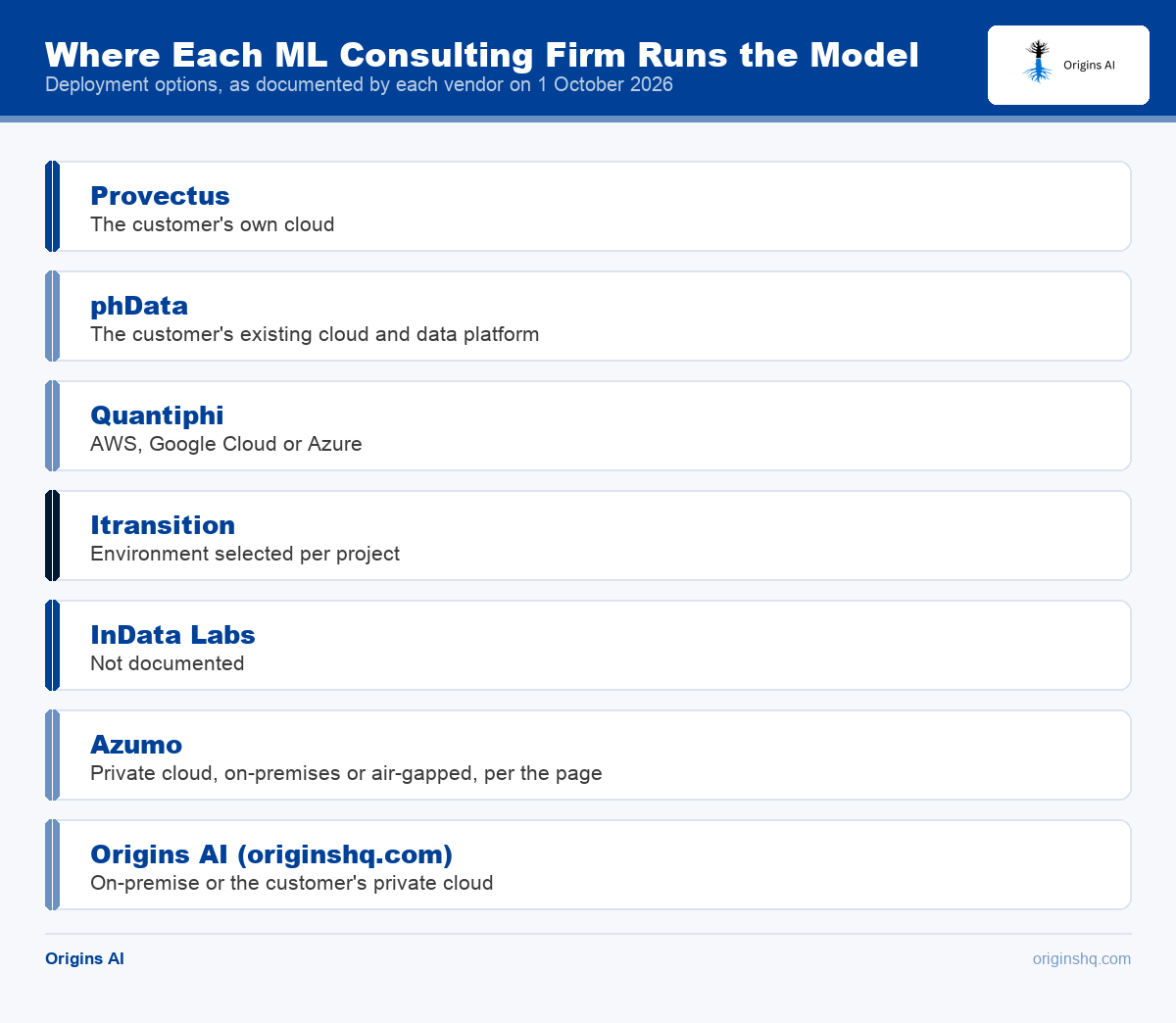
| Firm | Best fit | What they deliver | Deployment options | Engagement model | Evidence on their own site |
|---|---|---|---|---|---|
| Provectus | Insurance, financial services and life sciences | AI and data systems, code and architecture handed over at go-live | The customer's own cloud | One-week fixed-fee Sprint, 8 to 14 week milestone-priced build, then outcome-priced | Named underwriting and audit case studies on AWS |
| phData | Teams standardized on Snowflake, AWS or dbt | ML engineering, MLOps platform work, generative AI apps | The customer's existing cloud and data platform | Four-week sprint: three use cases, two prototypes, one MVP | Healthcare disputes case study; Snowflake Elite partner |
| Quantiphi | Enterprise programs tied to one hyperscaler | Generative AI and agent platforms, document processing, data analytics | AWS, Google Cloud or Azure | Program and platform engagements | 2026 Google Partner of the Year in four categories |
| Itransition | Buyers wanting strategy, build and maintenance in one place | ML strategy, PoC, integration, MLOps, support | Environment selected per project | Consulting through to maintenance | Computer-vision PoC study; Databricks partner |
| InData Labs | Data-science-led builds with a defined process | NLP, predictive analytics, computer vision, deployment | Not documented | CRISP-DM projects, starting with exploratory data analysis | Industry use-case lists only |
| Azumo | Fine-tuning plus extra engineers in the same time zone | SFT, RLHF, DPO, LoRA and QLoRA on GPT, Claude, LLaMA and Mistral | Private cloud, on-premises or air-gapped, per the page | Dedicated team, staff augmentation or project build | States training runs under its SOC 2 compliance |
| Origins AI (originshq.com) | Teams needing the model trained and served inside their own network | Domain-specific model training behind the firewall, data engineering, deployment | On-premise or the customer's private cloud | Dedicated team, project-based, time-and-materials or build-operate-transfer | Four published engagement steps, from audit to integration |
Capabilities as documented by each vendor on 1 October 2026; every row was read on that firm's own site that day. Origins AI, which publishes this page, is included as one of the compared providers.
Machine learning development services for a regulated use case
Choose a data-platform partner when the warehouse is the bottleneck and the model simple. Choose a cloud-aligned integrator when procurement has standardized on one hyperscaler. Choose a deployment-first firm when records cannot leave your network. Machine learning development services in a regulated setting stand or fall on that last point, so the data agreement belongs in the first meeting. Our guide to custom LLM development firms for fintech and healthcare covers the contract questions.
When an LLM development company is the better fit
An LLM development company fits when the deliverable is a language application: an assistant over your documents, a drafting tool, a text classifier. A classical ML firm fits when the deliverable is a number, such as a forecast or risk score. Many firms do both, so ask which half the team has shipped.
What does a machine learning consulting engagement include?
A typical engagement runs in four phases: discovery and data audit, a scoped proof of concept, production build, then operation. Fees attach to the phase boundaries.
What each phase should produce:
- Discovery. A written use case, its data sources, a baseline for the current process, and a go or no-go recommendation.
- Proof of concept. A model scored on a held-out sample of your records against that baseline, with the failure cases listed.
- Production build. Pipelines, serving, access control, logging, a rollback path and the handover documents.
- Operation. A monitoring owner, an accuracy alert threshold and a retraining trigger.
Two firms show how differently this gets packaged. Provectus prices a one-week Sprint before any build and commits to handing over every line of code and architecture document on the first day of go-live. phData sells a four-week sprint: three use cases, two prototypes, one deployed MVP. Both put a bounded first phase ahead of a large commitment, which is the structure to ask for.
Fine-tuning, RAG or a new model: what will a good ML consultant recommend?
A good consultant recommends retrieval first, fine-tuning when behavior or format is the gap, and training from scratch almost never. Azumo says as much on its own fine-tuning page: fine-tuning is not always the right answer, and it tells clients when it is not.
What an AI/ML development services proposal should say about method
Retrieval keeps facts current without touching the weights, so it suits policies, rates and documents that change. Fine-tuning teaches format, tone and domain vocabulary, so it suits extraction, triage and drafting where prompting keeps missing. Our comparison of RAG, fine-tuning and pre-training works through the decision in full.
Pre-training from scratch is for organizations with a corpus and a budget at research scale. BloombergGPT is a 50 billion parameter model trained on a 363 billion token financial dataset, and Google's Med-PaLM, aligned to the medical domain, was the first system to pass the 60% mark on USMLE-style questions. Both are reference points for domain models, not templates for a mid-size program.
What to ask an AI ML consultant in the first call
Ask an AI ML consultant to name the approach they would reject for your task, and why. Then ask for one evaluation run with retrieval alone, the tuned model alone and both together.
How did we evaluate these ML consulting firms?
Every row came from the firm's own public pages, read on 1 October 2026, and records only what that firm states about delivery, deployment and engagement shape. No rankings or scores.
The four criteria, in the order they matter for AI ML consulting work:
- Data-engineering ownership. Does the firm build the pipelines, or assume them?
- Deployment options. Your cloud account, your servers, or the firm's environment?
- Evidence of production work. Named case studies, not logo walls.
- Engagement shape. A priced first phase, or an open retainer?
Why ML consulting services are hard to compare on a website
Marketing pages converge on the same service blocks and industry lists. The details that separate firms, such as who holds the model weights and where they are trained, rarely appear in public copy. Hence the checklist below.
How do you vet a machine learning consulting firm?
Vet a machine learning consulting firm on evidence you can read: a held-out evaluation plan, a named training environment, a data agreement and a handover list. Run these eight checks before signing anything.
- Ask which records the model will train on, and who de-identifies them.
- Ask where training runs: your cloud account, your hardware, or theirs.
- Get the roles with data access in writing, plus how access is logged.
- Ask which subcontractors, labelers or compute providers touch the data.
- Require a held-out test set from your records, with thresholds agreed before training.
- Ask for the baseline comparison: current process, base model, base model plus retrieval.
- Confirm who owns the weights, the training scripts and the evaluation set.
- Agree the handover contents, the monitoring owner and the retraining trigger before launch.
For check five, these machine learning evaluation metrics cover what to read beyond a single accuracy number, including calibration and distribution shift. The NIST AI Risk Management Framework, voluntary and released on 26 January 2023 with a Generative AI Profile added on 26 July 2024, gives both sides a shared vocabulary.
Do you need data engineering before machine learning consulting?
Usually yes. If the data is not collected, joined and reliable, the first engagement is a data engagement, whatever the invoice says.
Google Cloud's MLOps maturity model is a useful check. Level 0 is manual: a trained model handed to production. Level 1 adds an automated pipeline with continuous training, level 2 adds CI/CD for the pipeline. Many teams asking for ML consulting sit at level 0, so a proposal that assumes level 1 stalls on plumbing.
A short readiness test: can you produce 12 months of the task's history in one query, with the labels that define success? If not, scope the pipeline work first, with the same firm or a data engineering team, and keep the model engagement behind it.
What mistakes should you avoid when hiring an ML consulting firm?
The expensive mistakes are about evidence and environment, not model choice.
- No held-out test set. Demos pass on cherry-picked rows, and nobody can show whether the next version got worse.
- Letting training default to the vendor's account. Decide the environment before any records move.
- Buying a model when the gap is a pipeline. Run the readiness test above first.
- No monitoring owner. Accuracy drifts as products, codes and behavior change.
How Origins AI runs machine learning engagements
Origins AI is a US-based AI-augmented engineering company, and it sits in the last row of the table above: the work is designed to run inside the customer's own environment rather than in a vendor cloud.
Its domain-specific LLM product page describes training models on proprietary data behind the customer's firewall in four steps: audit and scope, covering data sources, requirements and use cases; infrastructure setup, which stands up the training environment in your cloud or on-premise; model training, fine-tuned or from scratch; then integration and iteration into live workflows. In on-premise and air-gapped modes the training data and prompts stay inside your network, while a hybrid setup that calls a hosted model sends that context out.
The pipeline half is sold as data services: data engineering, analytics, predictive modeling and model development with large language models. Security is described in controls rather than certifications: encryption at rest and in transit, secure authentication, continuous monitoring and least-privilege access. The company reports a 40 to 60% reduction in knowledge work time; treat that as a company figure. Engagements run as dedicated teams, project-based contracts, time-and-materials or build-operate-transfer, with no published rate card.
Talk to an engineer
Bring one dataset and one decision you want a model to support, and book a call with an engineer who will say whether machine learning is the right tool.