Fine-tuned on your data, served on your hardware
LLM Development Services for US Private Deployments
LLM development services turn a general language model into one that does your task: fine-tuning on your own corpus, evaluation against a frozen baseline and serving on your hardware. Origins AI (originshq.com) provides them for US enterprises, with weights and training data kept in your environment. Origins AI reports 15+ delivered projects and a 5.0 Clutch rating across 12 reviews.
What LLM Development Services Cover
Three model workloads we take from experiment to production.
Fine-Tuning on Your Own Corpus
Training a base model on your proprietary data so it uses your vocabulary and formats. Our write-up summarises LISA, a layer-sampling method whose paper reports a 10-35% better MT-Bench score than LoRA at the same memory cost.
Read the fine-tuning write-upQuantisation and Self-Hosted Serving
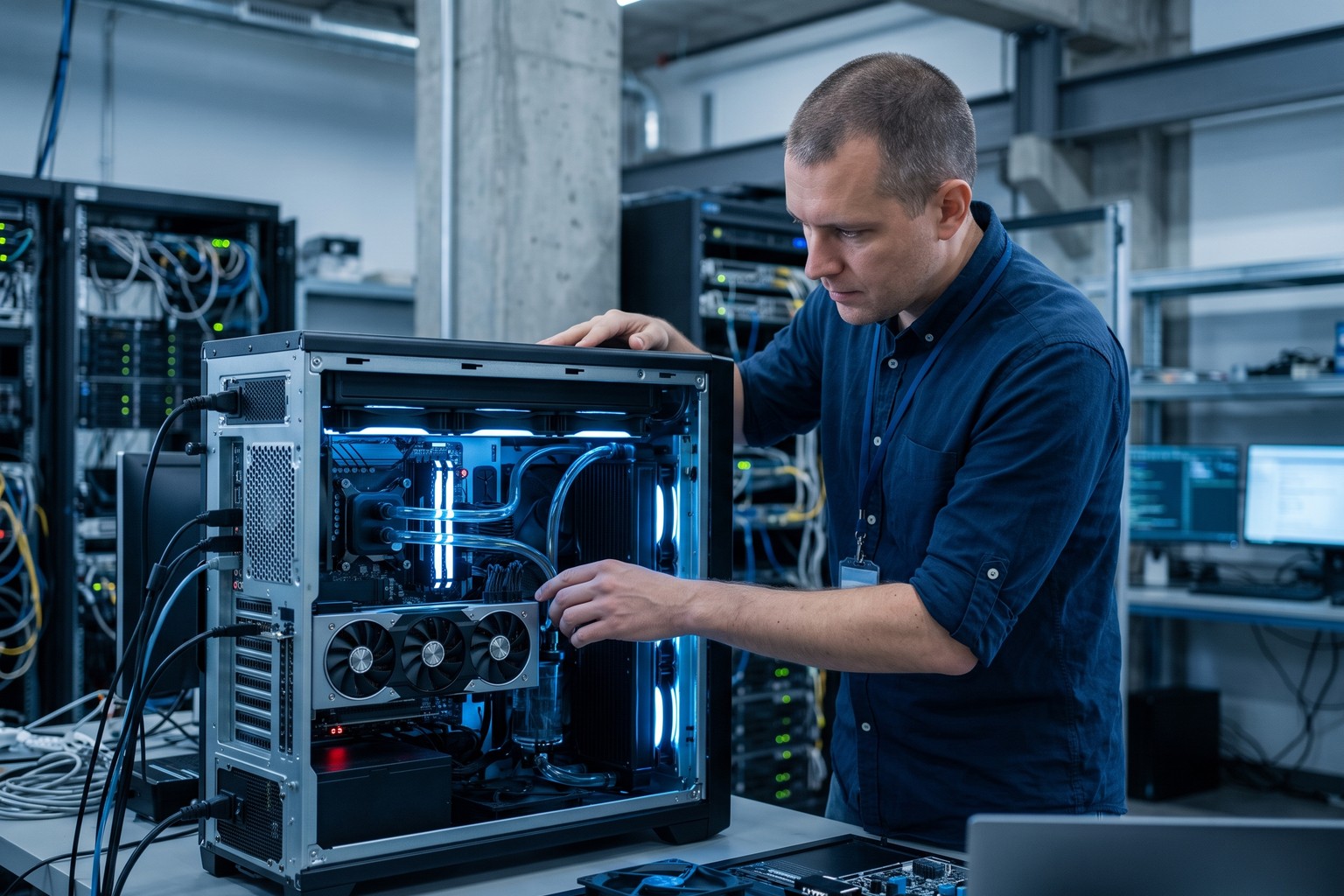
Getting an open-weight model to run on hardware your team already owns. We quantise to 4-bit and 5-bit GGUF with llama.cpp and measure memory headroom on the GPUs you intend to serve on, before a procurement order is signed.
Model Gateway and Routing
One gateway in front of every model, so a use case can move between providers without a rewrite. The chat platform page reports a pilot live in 2 weeks, with every model call logged for review.
See the platform
How a Domain Model Gets Built in 5 Steps
Decide whether a model is the answer
Build the dataset and the evaluation
Train, then compare honestly
Quantise and size the hardware
Serve it behind the gateway
Honest fit
When retrieval beats a fine-tuned model
Most of the time, retrieval is the cheaper and better answer. If the problem is that the model does not know your facts, give it your documents rather than retraining its weights, and you keep the ability to update a fact by editing a file. Fine-tuning earns its cost on form rather than knowledge: a house style the model must hold, a structured output it keeps breaking, a domain vocabulary it mangles, or a small model you need to punch above its size on your own hardware.

Why Origins AI
Why Choose Origins AI as Your LLM Development Company?
We will talk you out of it
If retrieval or prompt work solves the task, we say so before the training budget is committed. That advice is worth more than a model you did not need.
Measured against a frozen baseline
The evaluation set is written before training and never tuned towards, so the improvement we report is the improvement you get on work that matters to your team.
Weights and data stay with you
Training and serving run on your own servers or inside your own cloud account, in a United States region you choose. The tuned model is yours. Origins AI holds no security certifications and claims none.
No provider lock-in
Five model providers are supported, plus weights you host yourself, so a pricing change or a deprecation at one vendor does not become an application rewrite on your side.
The team that trains the models
An AI-augmented engineering company, US-headquartered
Origins AI (originshq.com) is a US-headquartered AI-augmented engineering company that builds self-hosted enterprise AI and stays on the rollout until it is running in production. Model work sits with the same engineers who deliver the data and cloud layers, which matters because serving a tuned model is an infrastructure problem as much as a research one. The stack supports 5 model providers (OpenAI, Anthropic, Meta Llama, Mistral and Google), or a model you have fine-tuned and host yourself. Origins AI reports 15+ delivered projects. The retrieval layer alongside it reports 1900+ data sources and 91+ document formats. Specialist teams can be staffed in as little as 72 hours where the engagement suits it, and Origins AI reports 10+ AI experts. Engagement runs as fixed-cost, milestone-based, a dedicated team, time and materials, or build-operate-transfer.
- 15+ delivered projectsAs Origins AI reports
- 1900+ data sourcesIn the retrieval layer
- 5 model providersPlus a model you host
Frequently asked questions about LLM development services
What are LLM development services?
Do we need LLM development services, or just retrieval?
Can LLM development services run inside our own network?
Which base models do you fine-tune?
How do you prove the tuned model is actually better?
Can a large model run on hardware we already own?
Do you offer LLM integration services as well as model training?
How much do LLM development services cost?
Still deciding?
Send the task and twenty examples of the output you want, and we will tell you whether training is needed.
Scope an LLM Fine-Tuning Pilot
Send the task you want a model to handle and the hardware you intend to serve it on. We book a technical call, walk the dataset and evaluation design, and map a pilot with no commitment required.
Tell us about the task
Tell us a bit about you and we'll be in touch shortly.